All Correct Solar

EL Imaging

Get rapid deployment to your site for high resolution EL Imaging.

Assess the Condition of Your Solar Panels

EL imaging is used to identify defects and potential issues in solar cells. It allows for the visualization of defects or damage that may not be apparent under normal operating conditions.

EL Imaging Use Cases

EL imaging has a diverse set of use cases, including:

  • Investigate cell level after infrared imaging
  • Investigate bad Bill of Materials (BOMs)
  • Post extreme weather event ‘health’ check up
  • Warranty claim
  • Insurance claim
  • Baseline
  • Construction quality control
  • Module supplier quality control

Standardization

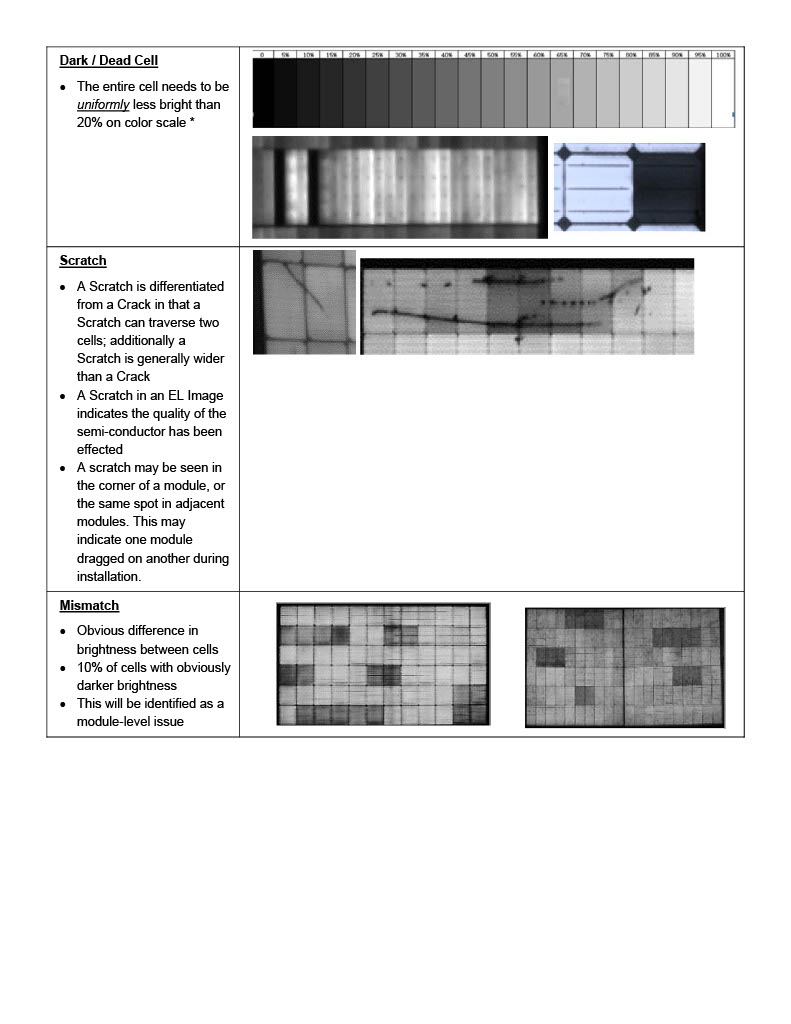
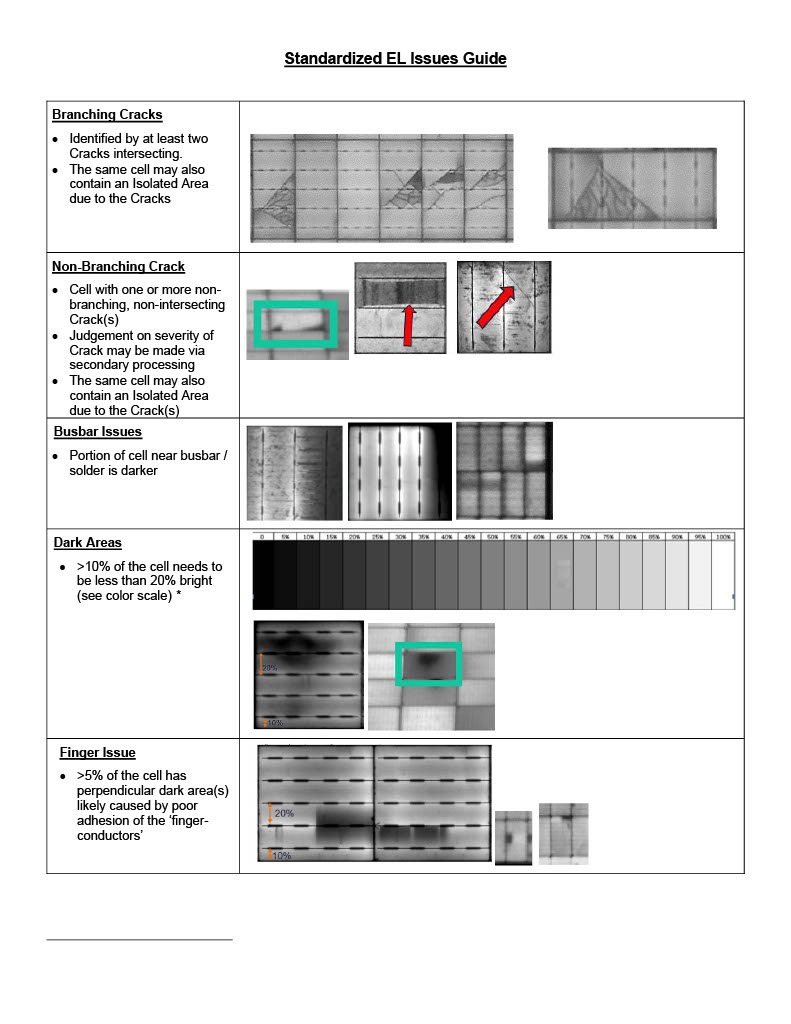
We’ve helped propel the industry forward with standardized EL issue guides.
PDF file image
Beryl Weinshenker
Example Issues Found With EL Imaging

These inspections may reveal defects and imperfections like:

  • Cracks and micro cracks
  • Insufficient soldering or busbar issues
  • Parts of the cell that are dead (not emitting any light, hence not capable of generating any power)
  • Manufacturing processing defects
  • Potential Induced Degradation (PID)
  • Thin-film shunting
  • Fire damage
  • Mismatch cells
  • Factory issues
  • Other cell-level issues

EL Imaging FAQs

What is EL Imaging?

EL imaging is a powerful, non-destructive technique that can identify otherwise undetected module issues, such as hidden micro-cracks that may cause accelerated degradation and underperformance. The principle behind EL imaging is fairly straightforward, just as PV modules produce electricity when light hits their surface, the reverse is also true—when a precise amount of electricity is injected into a module, light (in the infrared range) is emitted. EL imaging uses this to detect inactive or underperforming modules.

EL relies on the same principle as a light emitting diode (LED). Current is injected into a solar module, a radiative recombination of carriers causes light emission, and the EL image captures the forward-biased light. The amount of light emitted by a region of the module is proportional to the voltage potential of the region, so inactive regions appear dark on EL images.

  1. EL imaging is conducted on-site and does not require shipping PV modules to an off-site lab.
  2. Testing occurs while modules are installed on racks, eliminating the risk of damage caused by module removal